
Uncategorized
Tirzepatide Research Overview: Dual Agonism, Trial Designs and Lot Records
Sep
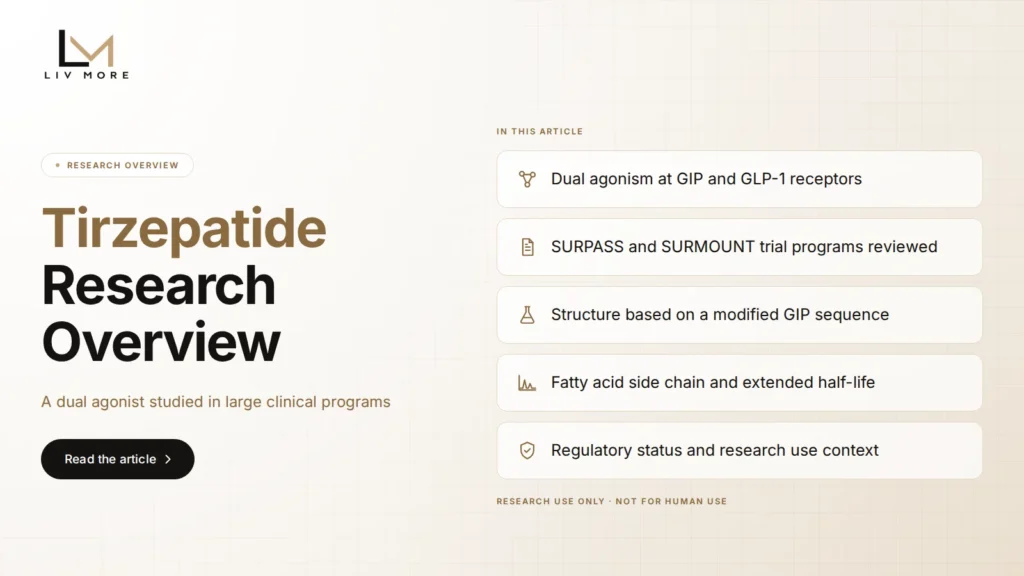
Tirzepatide, development code LY3298176, is a synthetic 39-residue lipidated peptide with agonist activity at two receptors: GIP and GLP-1. It is the active ingredient in FDA-approved medicines, and its published record runs from receptor pharmacology and mouse work to large phase 3 trial programs.
Those approvals cover specific drug products made, labeled and prescribed under their own terms. They do not extend to material supplied for laboratory research, and the identity of any specific material is settled by its lot record, not by the literature.
Tirzepatide is the most clinically established compound in this Journal. Where the BPC-157 research overview deals with a preclinical literature, and the retatrutide research overview with an investigational one, tirzepatide has approved products and years of published trials. That makes the line between an approved medicine and research material more important, not less. For any individual batch, the analytical side lives in the LIV More Lot Passport, where each lot’s purity, amount, test date and certificate are filed against the lot number printed on the vial.
All three profiles are listed in the Journal archive.
Every finding below is labeled by study type, and no study amounts or outcome figures are restated.
What tirzepatide is
Tirzepatide is a linear peptide of 39 residues, built on the sequence of the native hormone GIP and engineered with non-coded amino acids. A C20 fatty diacid side chain is attached to the peptide through a linker. In this class of molecule, a lipid side chain of that kind is used to extend circulating half-life through reversible binding to albumin. Its PubChem record gives the molecular formula C225H348N48O68 and a molecular weight of about 4813.
The molecule was described in a 2018 discovery paper in Molecular Metabolism written by scientists at Eli Lilly and Company, its developer. Early papers use the code LY3298176, and later papers use the name tirzepatide.
Peptide backbone
The 39-residue sequence derived from GIP, including its non-coded residues. It determines receptor binding at both targets and resistance to enzymatic breakdown.
Lipid side chain
The C20 fatty diacid and its linker. It adds substantial mass and makes the molecule far more hydrophobic than an unmodified peptide of the same length.
Salt form
Synthetic peptide is isolated as a salt, commonly a trifluoroacetate or an acetate. The counterion changes the formula weight and the peptide content by weight.
These distinctions have practical weight. The formula and mass in a public record describe the free peptide, so a certificate has to state which form its measured values refer to.
How tirzepatide acts at two receptors
Tirzepatide is a dual agonist, but its two actions are not equal. A 2020 study in JCI Insight by Willard and colleagues calculated receptor occupancy and found greater engagement of the GIP receptor than of the GLP-1 receptor. The authors called the profile imbalanced.
The same study examined signaling in cell lines and primary islets. At the GIP receptor, tirzepatide behaved much like native GIP. At the GLP-1 receptor, it favored cyclic AMP generation over β-arrestin recruitment and drove less receptor internalization than native GLP-1. The authors described this as biased agonism.
A receptor can signal through more than one pathway. A biased agonist activates some of those pathways more than the natural hormone does and others less. Bias is always measured against a reference ligand in a stated assay system, so it describes a relationship under laboratory conditions, not a fixed property of the molecule.
For analysts, the working point is that “dual agonist” is shorthand. The measured profile is unequal across the two receptors and pathway-specific at one of them, and how those cellular properties relate to effects in a whole organism remains a research question.
What published tirzepatide research examines
The record follows the usual path for a drug candidate, from cells and mice to phase 3 programs. Each item below names the design and what was measured.
- In vitro, animal model and phase 1. The discovery paper characterized signaling in cell lines expressing incretin receptors and measured body weight, food intake, insulin secretion and glycemic profiles in mice. Its phase 1 program combined single and multiple ascending dose studies in healthy participants with a proof of concept study in type 2 diabetes, using dulaglutide as a positive control. The primary objective was safety and tolerability.
- Phase 3, type 2 diabetes, placebo-controlled. SURPASS-1 was a 40-week, double-blind, randomized, placebo-controlled trial of tirzepatide as monotherapy in people not previously treated with injectable diabetes therapy. The primary endpoint was change in HbA1c at 40 weeks.
- Phase 3, type 2 diabetes, active comparator. SURPASS-2 was a 40-week, open-label trial comparing tirzepatide with semaglutide, a selective GLP-1 receptor agonist. The primary end point was change in glycated hemoglobin at 40 weeks.
- Phase 3, obesity. SURMOUNT-1 was a 72-week, double-blind, randomized, placebo-controlled trial in adults with obesity, or with overweight plus a weight-related condition, and excluded people with diabetes. Its coprimary end points were based on change in body weight. A three-year analysis followed participants who also had prediabetes for 176 weeks on treatment plus a 17-week off-treatment period, with onset of type 2 diabetes as a key secondary end point.
- Phase 3, obstructive sleep apnea. SURMOUNT-OSA comprised two 52-week, double-blind, randomized, placebo-controlled trials in adults with obesity and moderate to severe sleep apnea, split by whether participants used positive airway pressure therapy. The primary end point was change in the apnea-hypopnea index.
Every trial above was funded by the developer, and the conclusions belong to the authors and sponsor of each paper.
What the tirzepatide record does not establish
Approval settles questions about specific products. It leaves others open, and it does not transfer to anything outside those products.
- Approval is product-specific. The FDA approved Mounjaro for type 2 diabetes in 2022 and Zepbound for chronic weight management in 2023, and in December 2024 it added obstructive sleep apnea to Zepbound’s indications. Each approval covers a defined product, its manufacturing, its labeling and its indicated population.
- Research material is not an approved drug. Material supplied for laboratory research shares a name with those products and nothing else. It is not made, tested, labeled or supplied under their approvals.
- Trial findings belong to the trial product. Each trial studied a pharmaceutical product given under protocol with medical oversight. Its results say nothing about any other material.
- Mechanism remains open. Imbalance and bias were measured in engineered cells, islets and occupancy models. How much of the clinical profile they explain is still being studied.
- One sponsor. The foundational trials were funded by the developer. That is normal for a drug candidate, and it is worth knowing when reading them.
Regulatory context shapes how any of this can be written. The FDA has warned companies that sold unapproved tirzepatide products directly to consumers for human use, with dosing instructions, while labeling them for research purposes. Under 21 CFR 201.128, intended use is judged by the objective intent of the people responsible for an article, as shown through labeling claims, advertising and the circumstances of distribution. A label alone does not decide it. The Journal therefore describes study designs and measurements and stops there, and it restates no doses or outcome figures from any trial.
Reading a certificate for a tirzepatide lot
A certificate of analysis is the document that ties a physical vial to analytical data. The specifications of an approved drug product do not apply to research material, so a research lot’s certificate is the only analytical record that describes it.
Identity by mass is the first check. A molecule of about 4.8 kDa appears in electrospray spectra as several charge states at once, so the certificate should say whether the reported mass is a deconvoluted value and whether it refers to the free peptide or a salt form. HPLC purity is the second. The lipid side chain makes the molecule strongly retained on reversed-phase columns, and related impurities can include deletion sequences and variants of the side chain or linker, so the chromatogram for the same lot matters as much as the percentage. Amount is the third, and it should be read from the lot’s own record.
- Lot number on the certificate matches the vial label
- Stated form names the peptide and any counterion
- Observed mass agrees with the expected mass, stated as deconvoluted or as a named ion
- HPLC result and chromatogram are attached for the same lot
- Peptide content, if reported, is kept separate from HPLC purity
- Stated amount per vial matches the label on that lot
- Testing laboratory and test date are identified
The research use policy and the terms of sale set out the only terms on which LIV MORE LLC supplies research material. Storage and delivery are covered on the shipping and returns page, and recurring documentation questions are answered in the site FAQ.
To see how these fields appear on a real document, open the tirzepatide entry in the Lot Passport and check each item above against the record for that batch.
- Tirzepatide (LY3298176) is a synthetic 39-residue, GIP-based peptide carrying a C20 fatty diacid side chain
- It acts at the GIP and GLP-1 receptors, with greater GIP engagement and biased signaling at GLP-1
- Its record runs from cells and mice through the SURPASS and SURMOUNT phase 3 programs
- FDA approvals cover specific drug products, not research material that shares the name
- A lot certificate should confirm form, mass, purity with chromatogram, amount and lot number
Frequently asked questions
Tirzepatide, development code LY3298176, is a synthetic 39-residue peptide based on the sequence of the hormone GIP, with non-coded amino acids and a C20 fatty diacid side chain. PubChem gives its formula as C225H348N48O68. It acts as an agonist at the GIP and GLP-1 receptors and was developed by Eli Lilly and Company.
Imbalanced means tirzepatide engages the GIP receptor more than the GLP-1 receptor, based on receptor occupancy calculations published in 2020. Biased means that at the GLP-1 receptor it favors cyclic AMP signaling over β-arrestin recruitment, compared with native GLP-1. Both findings come from cell lines, islets and modeling, measured against reference hormones.
The record begins with a discovery paper covering cell signaling, mouse studies and phase 1 trials. The SURPASS phase 3 program studied type 2 diabetes, including a placebo-controlled monotherapy trial and an open-label comparison with semaglutide. The SURMOUNT program studied obesity, including a three-year analysis in people with prediabetes, and two trials in obstructive sleep apnea.
No. FDA approval covers specific drug products, with their own manufacturing, testing, labeling and indicated populations. Material supplied for laboratory research is not made or supplied under those approvals, and trial results for the approved products say nothing about it. Research material is for laboratory use only and is not for human or veterinary use.
A lot is identified by matching analytical data to a stated form. Mass spectrometry should give a mass consistent with the declared form, stated as a deconvoluted value or a named ion, since a lipidated peptide of about 4.8 kDa shows several charge states. HPLC should report purity with a chromatogram for the same batch. The certificate should also carry the lot number printed on the vial, the stated amount for that lot and the testing laboratory.
- Tirzepatide, compound summary. PubChem, National Center for Biotechnology Information. View source
- Coskun T, Sloop KW, Loghin C, et al., 2018. LY3298176, a novel dual GIP and GLP-1 receptor agonist for the treatment of type 2 diabetes mellitus: from discovery to clinical proof of concept. Molecular Metabolism, 18, 3 to 14. View source
- Willard FS, Douros JD, Gabe MB, et al., 2020. Tirzepatide is an imbalanced and biased dual GIP and GLP-1 receptor agonist. JCI Insight, 5, e140532. View source
- Rosenstock J, Wysham C, Frías JP, et al., 2021. Efficacy and safety of a novel dual GIP and GLP-1 receptor agonist tirzepatide in patients with type 2 diabetes (SURPASS-1): a double-blind, randomised, phase 3 trial. The Lancet, 398, 143 to 155. DOI
- Frías JP, Davies MJ, Rosenstock J, et al., 2021. Tirzepatide versus semaglutide once weekly in patients with type 2 diabetes. New England Journal of Medicine, 385, 503 to 515. DOI
- Jastreboff AM, Aronne LJ, Ahmad NN, et al., 2022. Tirzepatide once weekly for the treatment of obesity. New England Journal of Medicine, 387, 205 to 216. DOI
- Jastreboff AM, le Roux CW, Stefanski A, et al., 2025. Tirzepatide for obesity treatment and diabetes prevention. New England Journal of Medicine, 392, 958 to 971. DOI
- Malhotra A, Grunstein RR, Fietze I, et al., 2024. Tirzepatide for the treatment of obstructive sleep apnea and obesity. New England Journal of Medicine, 391, 1193 to 1205. View source
- FDA approves novel, dual-targeted treatment for type 2 diabetes. U.S. Food and Drug Administration, press announcement, May 2022. View source
- FDA approves new medication for chronic weight management. U.S. Food and Drug Administration, press announcement, November 2023. View source
- FDA approves first medication for obstructive sleep apnea. U.S. Food and Drug Administration, press announcement, December 20, 2024. View source
- FDA’s concerns with unapproved GLP-1 drugs used for weight loss. U.S. Food and Drug Administration, content current as of September 1, 2026. View source
- 21 CFR 201.128 (meaning of intended uses). Code of Federal Regulations, eCFR current edition. View source
- September 25, 2026: First published.
This article is general educational information about published research. It is not medical, legal or regulatory advice, and nothing in it describes or recommends the use of any compound in people or animals. Compounds discussed are for Research Use Only: not for human or veterinary use, not for diagnostic use, and not for use as a food, dietary supplement or cosmetic. Mounjaro and Zepbound are trademarks of Eli Lilly and Company, which is not affiliated with LIV MORE LLC. The LIV More Journal is published by LIV MORE LLC, which supplies research materials, including compounds discussed on this site. Links to certificates and policies are provided for lot documentation and policy reference.
