
Uncategorized
BPC-157 Research Overview: Sequence, Study Models and Lot Records
Sep
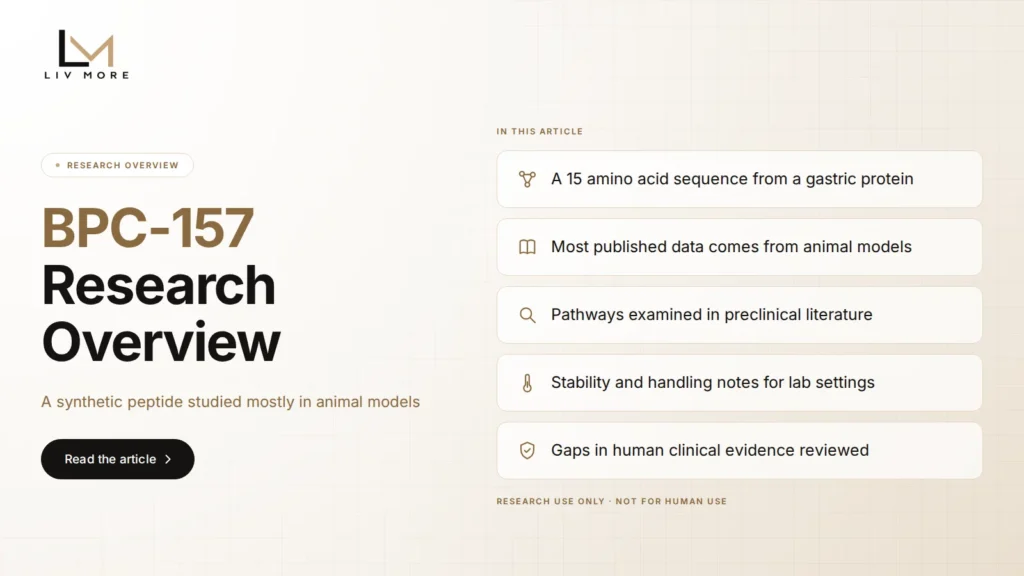
BPC-157 is a synthetic pentadecapeptide, a chain of 15 amino acids with the sequence GEPPPGKPADDAGLV. Its sequence is described as a partial fragment of a larger body protection compound isolated from human gastric juice. Its published literature is almost entirely preclinical: rodent injury models, cultured cells and a small number of uncontrolled human reports.
That literature describes what was measured in animals and cells. It does not establish effects in people, and the identity of any specific material is settled by its lot record, not by the literature.
BPC-157 has an unusual record. The number of animal papers is large, but most of them come from one research group, and human data is close to absent. This profile stays with the laboratory record. For any individual batch, the analytical side lives in the LIV More Lot Passport, where each lot’s purity, amount, test date and certificate are filed against the lot number printed on the vial.
It is the first compound profile in the LIV More Journal, and later profiles follow the same pattern in the Journal archive.
Every finding below is labeled by study type, and no study amounts are restated.
What the BPC-157 peptide is
BPC-157 is a linear peptide of 15 residues: glycine, glutamic acid, three prolines, glycine, lysine, proline, alanine, two aspartic acids, alanine, glycine, leucine and valine. Its PubChem record gives the molecular formula C62H98N16O22 and a molecular weight of 1419.5. The sequence contains no cysteine, methionine or tryptophan, so it has no disulfide bonds to form and none of the residues most prone to oxidation.
The name comes from the Zagreb research group that has published much of the record, where it is called a “stable gastric pentadecapeptide”. A 2020 review from that group describes it as continuously present in the gastric mucosa and gastric juice. Early papers also refer to it by development codes, including PL 14736 and PLD-116.
Free peptide
The uncharged 15-residue chain. Its formula and mass are the reference values, and every other form is compared against them.
Salt form
Synthetic peptide is usually isolated as a salt, most often an acetate. The counterion adds to the formula weight, so the stated form matters when a measured mass is compared with an expected one.
Peptide content
The share of a lyophilized solid’s weight that is the peptide itself. Water and counterions make up the rest, so peptide content is a different number from HPLC purity.
These distinctions have practical weight. Two vials both labeled BPC-157 can differ in counterion and peptide content while showing the same purity, and each difference changes what the analytical values should be.
Where the BPC-157 record comes from
The literature is large for a peptide with no approved use, but it is concentrated. A large share of the in vivo work, and many of the review articles that summarize it, were written by one group at the Department of Pharmacology, University of Zagreb. Independent laboratories, notably a group at Chang Gung University in Taiwan, have added mechanism work in cultured cells and rodent models.
A 2025 systematic review in HSS Journal searched PubMed, Cochrane and Embase up to June 2024 for musculoskeletal and safety literature. Of 36 included studies, 35 were preclinical and 1 was clinical, and the authors reported finding no clinical safety data.
A finding repeated across many papers from one laboratory is not the same as a finding replicated by independent groups. Shared methods, models and reagents can make results agree for reasons that have nothing to do with the compound. When a literature is concentrated, the count of papers overstates how settled it is.
For analysts, the working point is that the size of the BPC-157 literature says more about the attention it has drawn than about the strength of its evidence.
What published BPC-157 research examines
Most of the record falls into a few study types. Each item below names the model and what was measured.
- Animal model, tendon transection. Staresinic and colleagues transected the Achilles tendon in rats and compared BPC-157 with saline controls over two weeks. They measured load of failure, Young’s modulus, a functional index, tissue histology and defect size. The same paper included a cultured tendocyte experiment with 4-hydroxynonenal as a growth inhibitor.
- Cell culture, tendon fibroblasts. Chang and colleagues studied explants and fibroblasts from rat Achilles tendon. They measured explant outgrowth, proliferation by MTT assay, survival under hydrogen peroxide stress, transwell migration, cell spreading, F-actin formation and phosphorylation of FAK and paxillin. Proliferation was not directly affected. The other measures changed in a dose dependent way.
- Cell culture, gene expression. In a follow up study, the same group ran a cDNA microarray on treated rat tendon fibroblasts. They identified growth hormone receptor as one of the most up-regulated genes, then measured its mRNA and protein levels, cell proliferation with added growth hormone, and Janus kinase 2 activation.
- Angiogenesis, three models. Hsieh and colleagues used a chick chorioallantoic membrane assay, endothelial tube formation in human vascular endothelial cells and a rat hind limb ischemia model. They measured vessel density, blood flow recovery by laser Doppler, VEGFR2 expression and internalization, and VEGFR2, Akt and eNOS signaling.
These studies share a pattern. Each measures tissue or molecular markers under controlled laboratory conditions. None of them measures an outcome in a person, and the conclusions belong to the authors of each paper.
What the BPC-157 literature does not establish
The gaps are larger than the findings. Across the papers cited here, the evidence comes from rodent injury models, cultured cells and an avian membrane assay.
- No established human findings. The human literature consists of a retrospective chart review with telephone follow up and no control group, and a two participant pilot report. Neither design can establish an effect or a safety profile.
- Replication is limited. Much of the in vivo work comes from one group. Independent confirmation exists for some mechanisms in cultured cells, but not for most of the animal outcomes.
- Mechanism is not outcome. Changes in FAK phosphorylation, VEGFR2 signaling or receptor expression describe cell behavior in a dish. They do not predict what happens in a whole organism.
- Model markers are not endpoints. Tendon load of failure in a rat and vessel density in a chick membrane are laboratory measurements. They are not clinical endpoints.
- No approved use. BPC-157 holds no FDA approval for any human or veterinary use, and nothing in this profile evaluates any claim of that kind.
Regulatory context shapes how any of this can be written. The FDA lists BPC-157 among bulk drug substances that may present significant safety risks in compounding. It cites possible immunogenicity, complexities with peptide-related impurities and active ingredient characterization, and limited safety information. Under 21 CFR 201.128, intended use is judged by the objective intent of the people responsible for an article, as shown through labeling claims, advertising and the circumstances of distribution. The Journal therefore describes study designs and measurements and stops there.
Reading a certificate for a BPC-157 lot
A certificate of analysis is the document that ties a physical vial to analytical data. For a 15-residue peptide, two numbers get confused more often than any others: purity and peptide content.
HPLC purity is the first check. It reports the main peak’s share of the UV-absorbing material, and it should come with the chromatogram for the same lot. It does not measure water or counterion, so a lot can read high purity while its peptide content by weight is lower. Identity by mass is the second check. A peptide this size often appears in electrospray spectra as a multiply charged ion, so the certificate should say which ion was read and which form the expected mass refers to. Appearance is the third. A lyophilized peptide should be described as a dry solid consistent with the product record.
- Lot number on the certificate matches the vial label
- Stated form names the peptide and any counterion
- Observed mass agrees with the expected mass for that stated form, with the ion named
- HPLC result and chromatogram are attached for the same lot
- Peptide content, if reported, is kept separate from HPLC purity
- Stated amount per vial matches the label
- Testing laboratory and test date are identified
The research use policy and the terms of sale set out the only terms on which LIV MORE LLC supplies research material. Storage and delivery are covered on the shipping and returns page, and recurring documentation questions are answered in the site FAQ.
To see how these fields appear on a real document, open the BPC-157 entry in the Lot Passport and check each item above against the record for that batch.
- BPC-157 is a synthetic 15-residue peptide, GEPPPGKPADDAGLV, described as a fragment of a gastric juice protein
- Much of its large literature comes from a single research group
- Published work spans rodent injury models, cultured cells and angiogenesis assays
- No study cited here establishes any finding in people, and it holds no FDA approval
- A lot certificate should confirm form, mass, purity with chromatogram, amount and lot number
Frequently asked questions
BPC-157 is a synthetic pentadecapeptide with the sequence GEPPPGKPADDAGLV, the formula C62H98N16O22 and a molecular weight of 1419.5. It is described as a partial sequence of a body protection compound isolated from human gastric juice. Laboratory literature studies it in rodent injury models, cultured cells and angiogenesis assays.
The name comes from the research group at the University of Zagreb that has published much of the BPC-157 record. Pentadecapeptide means a chain of 15 amino acids. The group describes the peptide as present in the gastric mucosa and gastric juice, and uses “stable gastric pentadecapeptide” as its standard name in titles and reviews.
Published BPC-157 research mostly uses three model types. Rodent studies include Achilles tendon transection and hind limb ischemia, measuring biomechanics, histology and blood flow. Cell culture studies use rat tendon fibroblasts and human vascular endothelial cells, measuring migration, survival, gene expression and receptor signaling. Angiogenesis work also uses the chick chorioallantoic membrane assay. A 2025 systematic review found 35 preclinical studies and 1 clinical study in its musculoskeletal search.
It does not establish any effect in people. The human reports are a retrospective chart review without a control group and a two participant pilot, and neither design can establish effect or safety. Much of the animal work comes from one group, so independent replication is limited. Marker changes in cells and rodents are laboratory measurements, not clinical endpoints, and BPC-157 holds no FDA approval.
A lot is identified by matching analytical data to a stated form. Mass spectrometry should give a mass consistent with the declared form, with the ion named, since peptides of this size often appear as multiply charged ions. HPLC should report purity with a chromatogram for the same batch, and any peptide content figure should be kept separate from purity. The certificate should also carry the lot number printed on the vial, the stated amount and the testing laboratory.
- BPC-157, compound summary (CID 9941957). PubChem, National Center for Biotechnology Information. View source
- Sikiric P, Hahm KB, Blagaic AB, et al., 2020. Stable gastric pentadecapeptide BPC 157, Robert’s stomach cytoprotection/adaptive cytoprotection/organoprotection, and Selye’s stress coping response: progress, achievements, and the future. Gut and Liver, 14, 153 to 167. DOI
- Staresinic M, Sebecic B, Patrlj L, et al., 2003. Gastric pentadecapeptide BPC 157 accelerates healing of transected rat Achilles tendon and in vitro stimulates tendocytes growth. Journal of Orthopaedic Research, 21, 976 to 983. DOI
- Chang CH, Tsai WC, Lin MS, et al., 2011. The promoting effect of pentadecapeptide BPC 157 on tendon healing involves tendon outgrowth, cell survival, and cell migration. Journal of Applied Physiology, 110, 774 to 780. DOI
- Chang CH, Tsai WC, Hsu YH, Pang JH, 2014. Pentadecapeptide BPC 157 enhances the growth hormone receptor expression in tendon fibroblasts. Molecules, 19, 19066 to 19077. View source
- Hsieh MJ, Liu HT, Wang CN, et al., 2017. Therapeutic potential of pro-angiogenic BPC157 is associated with VEGFR2 activation and up-regulation. Journal of Molecular Medicine, 95, 323 to 333. DOI
- Lee E, Padgett B, 2021. Intra-articular injection of BPC 157 for multiple types of knee pain. Alternative Therapies in Health and Medicine, 27, 8 to 13. View source
- Lee E, Burgess K, 2025. Safety of intravenous infusion of BPC157 in humans: a pilot study. Alternative Therapies in Health and Medicine, 31, 20 to 24. View source
- Vasireddi N, Hahamyan H, Salata MJ, et al., 2025. Emerging use of BPC-157 in orthopaedic sports medicine: a systematic review. HSS Journal, 21, 485 to 495. View source
- Certain bulk drug substances for use in compounding that may present significant safety risks. U.S. Food and Drug Administration, content current as of April 22, 2026. View source
- 21 CFR 201.128 (meaning of intended uses). Code of Federal Regulations, eCFR current edition. View source
- September 25, 2026: First published.
This article is general educational information about published laboratory research. It is not medical, legal or regulatory advice, and nothing in it describes or recommends the use of any compound in people or animals. Compounds discussed are for Research Use Only: not for human or veterinary use, not for diagnostic use, and not for use as a food, dietary supplement or cosmetic. The LIV More Journal is published by LIV MORE LLC, which supplies research materials, including compounds discussed on this site. Links to certificates and policies are provided for lot documentation and policy reference.
